1 Connecting Principles to Outcomes
“I’m not trying to be pro-nuclear, or pro-wind, or pro-anything. I’m just pro-arithmetic.” – David MacKay
“Energy is the only universal currency: one of its many forms must be transformed to get anything done.” – Vaclav Smil
1.1 What Is “Post Scarcity”?
For most of human history, energy was the binding constraint on civilization. Muscles, both human and animal, provided nearly all mechanical work. Wood and dung provided heat. The average person in pre-industrial England had access to perhaps 2,000-3,000 kilocalories per day of food energy plus modest amounts of firewood for heating and cooking. The total energy at their command was perhaps 15-20 kWh per day, nearly all of it from contemporary photosynthesis.
This scarcity shaped everything. Cities could grow only as large as surrounding farmland could feed. Armies moved at the speed of horses. Manufacturing required locating workshops near flowing water. The vast majority of human labor went simply to maintaining biological existence.
The Industrial Revolution changed this equation fundamentally. When James Watt improved the steam engine in the 1760s and 1770s, he didn’t just create a new machine. He unlocked access to energy stores accumulated over hundreds of millions of years. Coal, formed from ancient swamp forests, contained the concentrated solar energy of the Carboniferous period. Later, petroleum and natural gas would unlock even denser energy reserves from marine organisms.
1.1.1 How Much Power Is a Human?
Before exploring what fossil fuels changed, it helps to calibrate how much power a human body actually represents. The calculation is simple:
\[ \frac{2{,}000 \text{ kcal/day} \times 4{,}184 \text{ J/kcal}}{86{,}400 \text{ s/day}} \approx 97 \text{ W} \approx 100 \text{ W} \]
You are, to the photons of the sun, roughly equivalent to a 100-watt lightbulb. This is your total metabolic power: the rate at which your body converts food into heat and work. Of that 100 W, only about 20-25 W is available for sustained mechanical output (and a fit cyclist can sustain perhaps 75 W for an hour).
This sets the baseline for everything that follows. When we say modern Americans use 250 kWh/day of primary energy, we mean they command roughly 10 kW of continuous power flow across all sectors, about 100 times their own metabolic rate. The Industrial Revolution didn’t just add energy; it multiplied each person’s effective power by two orders of magnitude.
1.1.2 The Magnitude of the Change
Consider the energy content of one gallon of gasoline: approximately 34 kWh. A fit human can sustain roughly 75 watts of mechanical output for an extended period (about 0.1 horsepower). To deliver 34 kWh of mechanical work at 75 watts would require:
\[ \frac{34 \text{ kWh}}{0.075 \text{ kW}} = 453 \text{ hours} \approx 57 \text{ eight-hour days} \]
One gallon of gasoline, costing a few dollars, contains the mechanical work equivalent of nearly three months of human labor. A car’s 15-gallon tank contains the equivalent of 850 eight-hour workdays, or over three years of full-time human effort.
This is what energy surplus means in quantitative terms. Modern industrial societies command energy flows that would have been unimaginable to our ancestors. The average American uses approximately 250 kWh per day across all sectors: electricity, transportation, heating, industrial processes, and the energy embedded in consumed goods. This represents roughly 20 times what a pre-industrial person could access.
1.1.3 Energy and Human Development
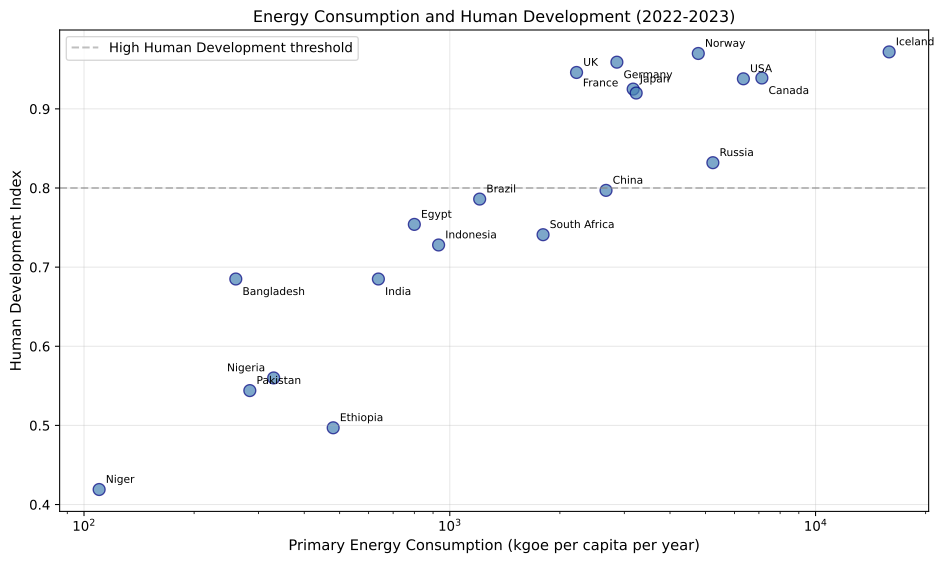
The relationship between energy consumption and human welfare is striking, and complicated. Figure 1.1 illustrates the relationship between per-capita primary energy consumption and the Human Development Index (HDI), a composite measure of life expectancy, education, and income developed by the United Nations.
The pattern reveals several important features:
Below approximately 1,000 kgoe per capita per year (roughly 30 kWh/day), additional energy consumption correlates strongly with improved HDI scores. Countries like Bangladesh, India, and much of Sub-Saharan Africa fall in this range. Here, more energy means longer lives, better education, and higher incomes: the basic constituents of human flourishing.
Between 1,000 and 3,000 kgoe per capita (30-100 kWh/day), the relationship continues but begins to flatten. Countries like Brazil, China, and Turkey have achieved relatively high HDI scores at moderate energy consumption levels.
Above roughly 4,000 kgoe per capita (125+ kWh/day), the curve essentially plateaus. The United States consumes roughly twice as much energy per capita as Germany, yet Germany’s HDI is slightly higher. Iceland, with extraordinary per-capita energy use due to its aluminum smelting industry, achieves comparable human development to Denmark at a fraction of Denmark’s consumption.
TipUnit Bridge: kgoe to kWh/day
To convert between the annual aggregate (kgoe/year) used in international statistics and the daily per-capita (kWh/day) used throughout this textbook: 1,000 kgoe/year \(\times\) 11.63 kWh/kgoe \(\div\) 365 days \(\approx\) 32 kWh/day. The two key thresholds are roughly 30 kWh/day (below which more energy strongly improves welfare) and 125 kWh/day (above which additional energy yields diminishing returns).
This pattern suggests two critical insights:
Energy poverty is a real and urgent problem. Approximately 750 million people lack access to electricity, and more than 2 billion lack access to clean cooking fuels (IEA World Energy Outlook 2024). For these populations, increased energy access is directly linked to improved welfare.
Above a threshold, more energy does not automatically mean more welfare. Rich countries could potentially maintain high living standards while significantly reducing energy consumption through efficiency improvements.
1.1.4 Planetary Pressures-Adjusted HDI (PHDI)
The standard HDI tells only half the story. The UNDP’s Human Development Report 2020 introduced the Planetary Pressures-Adjusted HDI (PHDI), which discounts a country’s HDI by its per-capita CO2 emissions and material footprint. The adjustment reveals a sobering reality: no country currently achieves high human development within planetary boundaries.
High-energy countries like the United States, Canada, and Australia see their scores drop significantly when environmental costs are included. Their high HDI comes at a planetary price. Meanwhile, countries with low environmental footprints tend to have low HDI, because they lack the energy access needed for development.
The goal of the energy transition, framed through the PHDI, is to move “up and left”: achieve higher human development with lower planetary pressure. This requires either:
- Decarbonizing the energy supply (so that high energy use no longer implies high emissions), or
- Improving energy productivity (so that less energy delivers the same welfare), or
- Both simultaneously, which is what most credible transition pathways require.
The PHDI reframes the Energy Trilemma as a design problem: can we build energy systems that deliver Security and Equity (high HDI) without sacrificing Sustainability (low planetary pressure)? No country has yet demonstrated this is possible at scale, but the declining costs of clean energy technologies suggest it may become achievable.
1.1.5 The Decoupling Question
The historical correlation between energy consumption, carbon dioxide emissions, and GDP has been remarkably tight. Figure 1.2 shows the long-run relationships.
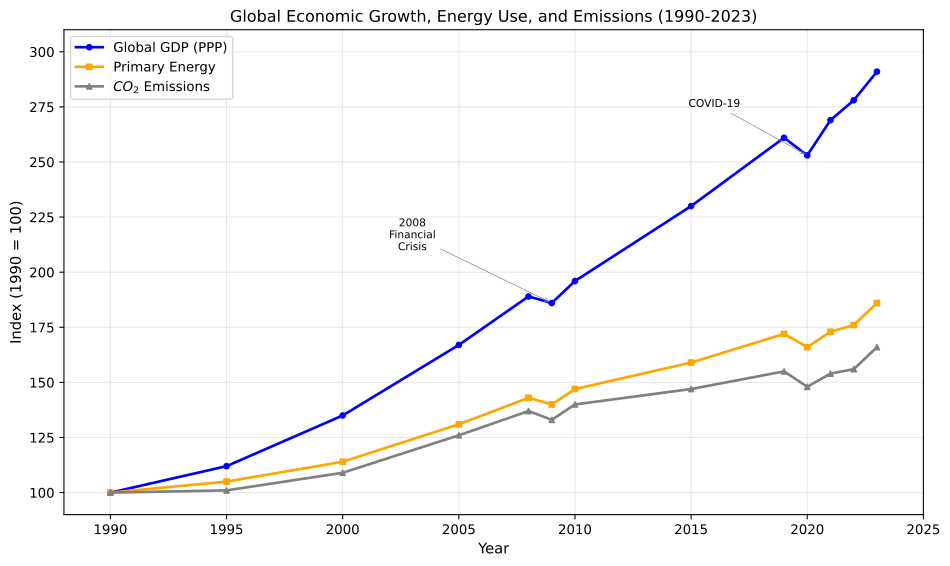
Several developed economies have achieved relative decoupling (GDP growing faster than energy consumption) and a handful have achieved absolute decoupling (growing GDP while energy use falls). The UK’s carbon emissions peaked in 1973; the US peaked around 2007; the EU peaked in 1979.
But these are deceptive statistics. Much of the apparent decoupling in wealthy countries reflects:
- Offshoring of manufacturing to countries like China, shifting emissions to where goods are produced rather than consumed
- Structural economic changes from manufacturing to services (which are less energy-intensive but still depend on energy-intensive inputs)
- Genuine efficiency improvements in heating, lighting, transportation, and industrial processes
When emissions are calculated on a consumption basis rather than territorial basis, accounting for the carbon embedded in imported goods, the picture looks considerably less optimistic. The United States’ consumption-based emissions are roughly 6% higher than territorial emissions; the UK’s are about 40% higher (Global Carbon Project; Our World in Data 2024).
ImportantThe Sustainable Energy Question
The fundamental challenge is not whether we can decouple welfare from energy use, at high consumption levels, (to the “right” of Germany) we clearly can. The challenge is whether we can decouple energy use from fossil use and/or carbon emissions fast enough to avoid catastrophic climate change. This is a question of technology, economics, and politics; not physics alone.
1.2 The Framework for Change
This textbook organizes energy analysis around a five-stage framework that connects fundamental science to measurable outcomes:
\[ \boxed{\text{Principle}} \leftrightarrow \boxed{\text{Technology}} \leftrightarrow \boxed{\text{Product}} \leftrightarrow \boxed{\text{Policy}} \leftrightarrow \boxed{\text{Outcome}} \]
1.2.1 Stage Definitions
Principle refers to the fundamental physics or chemistry that governs energy conversion. Principles set absolute limits: the Carnot efficiency bounds heat engines, the Shockley-Queisser limit bounds single-junction solar cells, conservation of energy is inviolable. No amount of engineering cleverness can circumvent a principle, though principles can sometimes be exploited in unexpected ways.
Examples of principles:
- Photovoltaic effect (photons exciting electrons across a bandgap)
- Nuclear fission (heavy nuclei splitting to release binding energy)
- Electrochemistry (electron transfer reactions at electrodes)
- Thermodynamics (heat flows from hot to cold; entropy increases)
Technology refers to the engineered system that exploits a principle. Technologies are constrained by principles but not determined by them. There are typically many technological approaches to exploiting a single principle, and the dominant technology often changes over time.
Examples of technologies:
- Silicon solar cells (one way to exploit the photovoltaic effect)
- Light water reactors (one way to sustain controlled fission)
- Lithium-ion batteries (one electrochemical storage approach)
- Combined cycle gas turbines (one way to convert chemical to electrical energy)
Product refers to the commercially available offering with defined specifications, warranties, and prices. Products emerge from technologies through manufacturing, quality control, and market development. The same underlying technology can generate products with vastly different characteristics depending on design choices and manufacturing processes.
Examples of products:
- JinkoSolar Tiger Neo 620W panel (efficiency: 22.3%, warranty: 25 years)
- Tesla Megapack (3.9 MWh capacity, 4-hour duration)
- Vestas V236-15.0 MW offshore wind turbine
- GE Vernova 7HA.03 gas turbine (64% combined cycle efficiency)
Policy encompasses the rules, incentives, and regulations that shape how products are deployed. Policy operates at multiple levels: national legislation, state regulations, utility commission decisions, building codes, international agreements. Policy can create markets, destroy them, accelerate deployment, or block it entirely.
Examples of policies:
- Investment Tax Credit (30% for solar under the IRA)
- Feed-in tariffs (guaranteed prices for renewable generation)
- Renewable Portfolio Standards (utilities must source X% from renewables)
- Carbon pricing (cap-and-trade or carbon taxes)
- Net metering (compensation for distributed generation)
- Permitting requirements (timelines, environmental review)
Outcome refers to the measurable results in the real world. Outcomes are what ultimately matter: they are why we care about energy systems in the first place. Outcomes include both intended effects (emissions reductions, lower costs) and unintended consequences (job losses, environmental justice impacts, grid reliability events).
Examples of outcomes:
- Grid emissions intensity (kg CO2/MWh)
- Retail electricity prices ($/kWh)
- System reliability (SAIDI, SAIFI metrics)
- Employment figures (direct and indirect jobs)
- Health impacts (premature deaths avoided, respiratory illness)
- Energy access rates (% of population with electricity)
1.2.2 Bidirectional Analysis
The framework operates in two directions, each revealing different insights:
Reduction to Practice (left-to-right) asks: Given what physics permits, how do we build technologies, commercialize products, design effective policies, and achieve desired outcomes?
This is the direction of innovation and deployment. It requires:
- Understanding physical limits before promising outcomes
- Engineering within those limits to create viable technologies
- Scaling manufacturing to produce affordable products
- Designing policies that accelerate beneficial deployment
- Measuring outcomes to verify that policies work
Reduction to Understanding (right-to-left) asks: Observing outcomes in the world, what do they reveal about the policies, products, technologies, and principles at work?
This is the direction of analysis and learning. It involves:
- Measuring outcomes carefully (emissions, costs, reliability)
- Attributing outcomes to specific policies
- Understanding how product characteristics affect outcomes
- Tracing technology choices back to underlying principles
- Identifying where physical limits might explain observed patterns
TipExample: The Solar Learning Curve
Reduction to Practice: The photovoltaic effect (principle) enables silicon solar cells (technology), which are manufactured into commercial panels (product). Feed-in tariffs and tax credits (policy) created guaranteed markets that drove manufacturing scale and cost reductions (outcome: 87% cost decline since 2010, per IRENA 2024).
Reduction to Understanding: Solar became the cheapest source of new electricity in most regions (outcome). Why? Consistent policy support (policy) enabled massive manufacturing investment (product). Factory learning and scale economics (technology) drove down costs toward theoretical material limits (principle). The experience curve shows approximately 23% cost reduction per doubling of cumulative production, a pattern explained by a combination of manufacturing refinements, R&D improvements, and supply chain optimization.
1.2.3 Critical Questions at Each Stage
As you work through subsequent chapters, keep these questions in mind at each stage of the framework:
Principle → Technology: When is a technology “ready”? Who decides? Smil argues that energy transitions take 50-70 years. Can we accelerate that? Should we?
Technology → Product: When do we stop inventing and start deploying? MacKay’s stance, “I’m pro-arithmetic,” demands we ask: what numbers matter most?
Product → Policy: Who gets to decide policy? Scientists? Markets? Voters? Is no policy a policy? As Steven Chu observed, “The Stone Age didn’t end because we ran out of stones.”
Policy → Outcome: How do we measure success? GDP? Emissions? HDI? PHDI? What if the outcome isn’t what we intended?
These questions have no universal answers. They require judgment, evidence, and the willingness to engage with tradeoffs. Being “pro-arithmetic” means insisting that all claims be quantifiable, that magnitudes matter, that dimensions must be consistent, and that orders of magnitude reveal feasibility before detailed analysis begins.
1.2.4 Why Historical Direction Matters
A crucial insight from history: scientific understanding often follows practical need, not the reverse.
Steam engines came before thermodynamics. Thomas Newcomen built his atmospheric engine in 1712. James Watt dramatically improved it in the 1760s. Sadi Carnot published his analysis of the theoretical limits of heat engines in 1824, after steam engines had been running for over a century. The Laws of Thermodynamics as we know them were formalized by Clausius and Kelvin in the 1850s.
The practical problem (pumping water from mines) drove the technology. The technology’s limitations stimulated the science. The science then enabled better technology.
Semiconductor physics developed partly because Bell Labs needed better switches for telephone networks. The transistor (1947) emerged from industrial research into solid-state devices. Only afterward did the full theoretical understanding of semiconductor band structure become standard curriculum.
Battery chemistry advances today are driven by market demand for electric vehicles and grid storage. Pure curiosity did not motivate the massive investment in lithium-ion improvements; Tesla’s market cap did.
This pattern has implications for energy transition strategy. We should not wait for perfect scientific understanding before deploying solutions, since practical need accelerates understanding. But neither should we ignore physical limits in our optimism, because those limits will eventually assert themselves. The framework helps navigate between these extremes.
1.3 The Energy Trilemma
Every energy decision involves tradeoffs among three fundamental objectives. The World Energy Council formalized this as the “Energy Trilemma,” though the underlying tensions are much older than the name.
1.3.1 Security
Energy security means reliable supply that meets demand when and where it is needed. The concept encompasses several distinct elements:
Physical reliability is the most immediate concern: Do the electrons flow when you flip the switch? Does the fuel arrive when you need it? Modern economies have near-zero tolerance for blackouts and fuel shortages. The 2021 Texas winter storm, which caused widespread power outages and over 200 deaths, illustrated the catastrophic consequences of reliability failures.
Supply chain resilience addresses longer-term vulnerabilities: What happens if a key supplier is disrupted? The 1973 Arab oil embargo demonstrated how concentrated supply could be weaponized. Today, similar concerns surround China’s dominance in solar panel manufacturing (>80% of global capacity) and battery material processing (60-70% for lithium and cobalt refining) (IEA Solar PV Global Supply Chains 2022; IEA Global Critical Minerals Outlook 2025).
Fuel diversity provides insurance against price shocks: An economy dependent on a single fuel is vulnerable to supply disruptions and price volatility affecting that fuel. Diversified energy systems that draw on domestic and imported sources, multiple fuels, and multiple suppliers are more resilient.
Domestic production offers a different form of security: Energy produced within national borders is less vulnerable to international disruptions, though it may be more expensive than imports. The United States’ shale revolution transformed it from a major oil importer to a potential exporter, fundamentally changing its energy security calculus.
ImportantSecurity as the Zeroth-Order Concern
In the Energy Trilemma, security functions analogously to the Zeroth Law of Thermodynamics: it must be satisfied before the other dimensions even make sense. You cannot optimize for equity or sustainability in a system that doesn’t reliably work.
A hospital that loses power. A city without heating in winter. An economy without transportation fuel. These are not incremental problems but existential threats. Energy security is a threshold good: below a minimum level, everything else falls apart.
1.3.2 Equity
Energy equity concerns the distribution of costs and benefits across populations. Several dimensions matter:
Affordability asks: Can households afford adequate energy for heating, cooling, lighting, and cooking? Energy poverty (defined variously as spending more than 10% of income on energy, or lacking access to adequate heating/cooling) affects millions even in wealthy countries. In 2020, 34 million American households (27%) reported difficulty paying energy bills or keeping their home at a safe temperature (EIA Residential Energy Consumption Survey 2020).
Access asks: Do all communities have reliable energy infrastructure? Globally, approximately 750 million people lack access to electricity, concentrated in Sub-Saharan Africa and South Asia (IEA 2024). Within wealthy countries, rural and remote communities often face higher energy costs and less reliable service.
Burden distribution asks: Who bears the environmental and health costs of energy production? Power plants, refineries, and mines are disproportionately located near low-income and minority communities. The emerging clean energy economy creates its own distributional questions: lithium mining impacts, wind farm siting, grid infrastructure routes.
Employment asks: Where are energy jobs created and lost? Transitions create winners and losers. Coal mining regions face job losses while solar installation grows. The geographic mismatch between declining and growing industries creates profound local impacts even if aggregate employment is unchanged.
The green premium, or the additional cost of clean alternatives relative to fossil incumbents, is central to equity analysis. When clean options cost more, who can afford them? Wealthy households install rooftop solar and buy electric vehicles; low-income households continue using aging gas-powered cars and renting housing where they have no control over energy systems.
1.3.3 Sustainability
Environmental sustainability addresses long-term consequences across multiple dimensions:
Climate is the most prominent sustainability concern. The physics is unambiguous: atmospheric CO2 has increased from 280 ppm pre-industrial to over 422 ppm in 2024 (NOAA). The global average temperature increased by approximately 1.1°C through 2011-2020 (IPCC AR6), with 2024 reaching 1.5°C above pre-industrial levels. Continued fossil fuel combustion will cause further warming, with consequences including sea level rise, extreme weather intensification, agricultural disruption, and ecosystem destruction.
Local pollution encompasses air, water, and land quality impacts from energy production and use. Fine particulate matter (PM2.5) from fossil fuel combustion causes approximately 8.7 million premature deaths annually worldwide, more than HIV/AIDS, malaria, and tuberculosis combined (Vohra et al. 2021, Environmental Research). Water pollution from coal mining, fracking, and power plant cooling affects communities near these facilities.
Resource depletion asks: Are we drawing down stocks faster than they regenerate? Fossil fuels are finite on any relevant timescale. Critical minerals for clean energy technologies (lithium, cobalt, rare earths) exist in limited quantities in economically accessible deposits.
Ecosystem impacts include land use transformation, biodiversity loss, and habitat fragmentation. Solar and wind farms require significant land area compared to fossil fuel plants. Hydroelectric dams alter river ecosystems. Mining disrupts landscapes. Even “clean” energy has environmental footprints.
NoteSustainability Now Is Equity Later
A critical insight connects sustainability to equity: environmental damage imposes costs on future generations who have no voice in today’s decisions.
Climate change will disproportionately harm people not yet born, populations in developing countries, and species that cannot vote in any election. When we discount these future costs in present-value calculations, we embed ethical judgments about whose welfare matters.
This is why sustainability cannot simply be traded off against present-day equity or security. The tradeoff is partly between current and future generations, and the future generations have no representative at the table.
1.3.4 The Trilemma as Trade-off Space
No country has solved all three dimensions of the trilemma simultaneously. Every energy system reflects choices among competing objectives.
| Country | Security | Equity | Sustainability | Trade-offs Made |
|---|---|---|---|---|
| Norway | High | High | High | Exceptional hydro resources; exports oil/gas emissions |
| Denmark | Medium | High | High | Relies on interconnections; among highest electricity prices |
| USA | High | Medium | Low | Energy-intensive lifestyle; significant energy poverty |
| Germany | Medium | Medium | Medium | Nuclear phase-out increased emissions; high industry costs |
| China | Medium | Medium | Low | Rapid growth prioritized; massive coal fleet |
| India | Low | Low | Medium | Expanding access prioritized; infrastructure constraints |
These characterizations are necessarily simplified. Every country’s situation involves nuances that a single table cannot capture. The point is that different societies, facing different resource endowments and political constraints, have resolved the trilemma differently. There is no universal “right” answer, only choices with consequences.
TipFramework Connection
The Energy Trilemma operates at the Outcome level of our framework. But every element of the chain (Principle, Technology, Product, Policy) shapes how the trilemma resolves. Physical principles limit what’s possible. Technologies determine what’s practical. Products set costs. Policies allocate costs and benefits. Understanding this chain is essential to navigating the trilemma.
1.4 Quantifying Energy
Before we can analyze energy systems, we need a shared vocabulary for measurement. Energy literacy starts with mastering units.
1.4.1 Energy vs. Power
Energy is the capacity to do work. It is a stock, an amount that can be stored, transferred, and converted.
Power is the rate at which energy is transferred or converted. It is a flow, an amount per unit time.
The relationship: \[ \text{Power} = \frac{\text{Energy}}{\text{Time}} \quad \text{or equivalently} \quad \text{Energy} = \text{Power} \times \text{Time} \]
This distinction is crucial and frequently confused: - A battery’s capacity (in kWh) determines how much energy it stores - A battery’s power rating (in kW) determines how fast it can charge or discharge - You can have high capacity with low power (car battery: charges slowly over hours) - You can have high power with low capacity (capacitor: discharges in milliseconds)
1.4.2 SI Units
The joule (J) is the SI unit of energy. One joule is the work done by a force of one newton acting through a distance of one meter. Equivalently, it is the energy dissipated by one watt of power operating for one second.
The watt (W) is the SI unit of power. One watt equals one joule per second.
Standard SI prefixes scale these units:
- kilo (k) = 103: 1 kW = 1,000 W
- mega (M) = 106: 1 MW = 1,000,000 W
- giga (G) = 109: 1 GW = 1,000,000,000 W
- tera (T) = 1012: 1 TW = 1,000,000,000,000 W
Energy prefixes similarly: kJ, MJ, GJ, TJ.
1.4.3 Practical Energy Units
In practice, energy is measured in several non-SI units that persist for historical and practical reasons:
Kilowatt-hour (kWh): The energy delivered by one kilowatt of power over one hour. \[ 1 \text{ kWh} = 1,000 \text{ W} \times 3,600 \text{ s} = 3,600,000 \text{ J} = 3.6 \text{ MJ} \]
Electricity is billed in kWh because it’s a convenient scale for household consumption (10-30 kWh/day is typical).
British Thermal Unit (BTU): The energy required to raise one pound of water by one degree Fahrenheit. \[ 1 \text{ BTU} = 1,055 \text{ J} \]
BTUs persist in U.S. heating and cooling contexts. A home furnace might be rated at 80,000 BTU/hr; an air conditioner at 12,000 BTU/hr (one “ton” of cooling).
Tonne of oil equivalent (toe): The energy content of burning one metric ton of crude oil. \[ 1 \text{ toe} = 41.87 \text{ GJ} = 11,630 \text{ kWh} \]
National and global energy statistics often use toe (or Mtoe = million tonnes oil equivalent) because it provides a single scale for comparing diverse energy sources.
Calorie and kilocalorie: The calorie (cal) is the energy to raise one gram of water by one degree Celsius. The kilocalorie (kcal) or “food Calorie” (capital C) equals 1,000 cal. \[ 1 \text{ kcal} = 4,184 \text{ J} = 1.16 \text{ Wh} \]
A 2,000 kcal daily diet thus represents about 2.3 kWh of chemical energy.
Quad: One quadrillion BTU = 1015 BTU = 1.055 EJ. U.S. energy statistics traditionally use quads; the U.S. consumed about 97 quads in 2023.
NoteUnit Conversion Reference
| Unit | Joules | kWh |
|---|---|---|
| 1 kWh | 3.6 × 10⁶ | 1 |
| 1 BTU | 1,055 | 2.93 × 10⁶ |
| 1 toe | 4.19 × 10¹¹ | 11,630 |
| 1 kcal | 4,184 | 1.16 × 10⁻³ |
| 1 quad | 1.055 × 10¹⁸ | 2.93 × 10¹¹ |
1.4.4 Developing Intuition
MacKay insisted that energy literacy requires developing intuition for what quantities mean in physical terms. Abstract numbers become meaningful only when connected to experience.
What does 1 kWh feel like?
- Run a 100-watt incandescent bulb for 10 hours
- Run a 10-watt LED for 100 hours (same light output as the incandescent)
- Drive an efficient EV approximately 3-4 miles
- Heat 10 liters of water from 15°C to boiling
- Run a typical laptop for 25-40 hours
- Run a window air conditioner for about 1 hour
- Power a typical refrigerator for 6-8 hours
- Costs approximately $0.10-0.25 in residential electricity rates
What does 1 kW feel like?
- A human at maximum sustained exertion outputs about 75-100 W (0.1 kW)
- A typical microwave oven: 1-1.5 kW
- An electric kettle: 1.5-3 kW
- A hair dryer: 1-2 kW
- A small car’s engine at highway cruise: 15-25 kW
- A city bus engine: 100-200 kW
- A large wind turbine: 2,000-15,000 kW
What does 1 MW feel like?
- Could power approximately 750-1,000 average U.S. homes
- A large diesel locomotive: 3-4 MW
- A single GE 9HA gas turbine: 571 MW
- The largest offshore wind turbine (Vestas V236): 15 MW
Scale references:
- Average U.S. home electricity: ~30 kWh/day, peak demand ~5 kW
- Average U.S. per-capita primary energy: ~250 kWh/day (including all sectors)
- U.S. total electricity generation: ~4,100 TWh/year
- Global electricity: ~29,000 TWh/year
- Global primary energy: ~580 EJ/year ≈ 160,000 TWh/year
1.4.5 Power Density: The Smil Perspective
Vaclav Smil has emphasized power density, or power per unit land area (W/m2), as a crucial metric for comparing energy sources. This perspective reveals constraints that discussions focused only on costs often miss.
Different energy sources deliver vastly different power densities:
| Source | Typical Power Density (W/m2) |
|---|---|
| Solar PV (average output) | 5-20 |
| Wind turbines (land area basis) | 1-3 |
| Biomass/biofuels | 0.1-0.6 |
| Natural gas plant (plant footprint) | 200-2,000 |
| Coal plant (plant footprint) | 100-1,000 |
| Nuclear plant (plant footprint) | 500-1,000 |
| Hydro (reservoir-based, varies widely) | 1-50 |
The implications are significant. To replace a 1 GW gas plant with solar panels at 10 W/m2 average output requires: \[ \frac{1 \times 10^9 \text{ W}}{10 \text{ W/m}^2} = 10^8 \text{ m}^2 = 100 \text{ km}^2 \]
That’s a square roughly 10 km on a side: not prohibitive, but not trivial either. For biofuels at 0.5 W/m2, the same 1 GW would require 2,000 km2, an area larger than Los Angeles.
Smil argues that this power density gap is underappreciated in energy transition discussions. Modern civilization’s demand for power concentration (in cities, factories, data centers) creates a “mismatch” with diffuse renewable sources that must be addressed through either massive land use or acceptance of power density constraints.
We will return to power density throughout this textbook, particularly when analyzing the feasibility of large-scale renewable deployment.
1.4.6 The Back-of-Envelope Philosophy
Throughout this textbook, we will practice order-of-magnitude estimation: getting answers right to within a factor of 2-3 using simple models and round numbers. This skill matters for several reasons:
Error checking: If a spreadsheet says a rooftop solar system produces 50 MWh/day, you should immediately recognize something is wrong. That’s enough to power 1,500 average homes, not one house.
Quick feasibility assessment: When someone claims a technology will solve a problem, back-of-envelope math often reveals whether the claim is plausible before any detailed analysis.
Identifying what matters: Which variables have the biggest impact on an answer? Quick calculations reveal sensitivities.
Cutting through rhetoric: Energy debates are often clouded by vague claims about “clean,” “cheap,” or “abundant.” Numbers discipline the conversation.
NoteBack-of-Envelope: Land Area for U.S. Electricity
Question: How much land would it take to generate all U.S. electricity with solar panels?
Given:
- U.S. electricity generation: ~4,000 TWh/year
- Solar insolation in Southwest: ~2,000 kWh/m2/year
- Panel efficiency: ~20%
- Capacity factor and system losses: reduce output by ~25%
Calculation: Useful electricity per m2: 2,000 × 0.20 × 0.75 = 300 kWh/m2/year
Area needed: 4 × 10¹² kWh ÷ 300 kWh/m2 = 1.3 × 10² m = 13,000 km2
That’s a square about 115 km × 115 km, roughly half the size of Massachusetts.
Reality check: The continental U.S. is about 8,000,000 km2. We’d need about 0.16% of the land area, a substantial amount but far from the entire country.
What this reveals: Land area is not the binding constraint on solar. The challenges lie elsewhere: intermittency, grid integration, supply chains, permitting.
1.5 Summary
This chapter established the foundations for our analysis:
Energy surplus transformed human civilization, enabling development far beyond what muscle power alone could achieve. But the correlation between energy consumption and welfare flattens above a threshold, and efficiency gains are possible without sacrificing wellbeing.
The Framework for Change connects Principle → Technology → Product → Policy → Outcome, operating bidirectionally as Reduction to Practice (left-to-right) and Reduction to Understanding (right-to-left).
The Energy Trilemma (Security, Equity, Sustainability) structures our evaluation of every energy source and policy. No solution dominates on all three dimensions; tradeoffs are inherent.
Quantitative literacy (mastery of units, conversion factors, and order-of-magnitude estimation) is essential for cutting through rhetoric and evaluating claims.
Power density reveals constraints that cost comparisons alone can miss, particularly the land requirements of diffuse energy sources.
In the next chapter, we examine the physical laws that govern all energy conversions: the principles that set hard limits on what any technology can achieve.
1.6 Readings
- David MacKay, Sustainable Energy - Without the Hot Air, Chapters 1-2: withouthotair.com/c1/page_2.shtml
- World Energy Council, World Energy Trilemma Index 2024: worldenergy.org/transition-toolkit/world-energy-trilemma-index
- UNDP, Human Development Report 2023-24, Chapter 1: hdr.undp.org/content/human-development-report-2023-24
- IEA, World Energy Outlook 2024 (Executive Summary): iea.org/reports/world-energy-outlook-2024
1.7 Exercises
Personal Energy Audit: Calculate your daily energy consumption in kWh across all sectors (electricity, transport, heating). Compare to the national average (~250 kWh/day total primary energy). What are your largest uses?
Energy and Development: Using data from the World Bank or IEA, plot energy consumption vs. HDI for 20 countries spanning the development spectrum. What pattern do you observe? Identify outliers above and below the trend line. What explains them?
Framework Application: Select a recent energy policy announcement (IRA provision, state renewable standard, carbon pricing scheme). Map it through the Framework for Change: What principles and technologies does it affect? What products will it promote? What outcomes does it seek?
Trilemma Analysis: Choose one energy source not discussed in detail in this chapter (hydropower, geothermal, or biomass). Write one paragraph each on its Security, Equity, and Sustainability implications. Where are the tradeoffs?
Back-of-Envelope Practice: Estimate the land area required to meet New York City’s electricity needs (~50 TWh/year) with solar panels. How does this compare to NYC’s land area (~780 km2)? What does this imply about where NYC’s solar power would need to come from?
The Trilemma Trade-off: Iceland achieves very high scores on all three trilemma dimensions. Research its energy system and identify what makes this possible. Why can’t other countries simply replicate Iceland’s approach?